
The problem
I founded SuperEstar and took it from a research question to a live two-sided marketplace, where fans and brands pay a star for a personal video, a like or comment on their post, or a video call. I ran the research, designed the product and the service around it, launched it, and in 2026 rebuilt it in English and Persian.
Fans wanted to get closer to the people they follow, and no platform made that feel secure and personal for either side. Stars wanted new ways to earn from their audience without handing their whole life to it. That gap is the whole business.
A marketplace like this lives or dies on balance. It needs enough stars to draw fans and enough fans to keep stars, prices that don't push fans away, and room to follow entertainment trends that move fast.
Who it's for, and what they'd pay
My research handed SuperEstar its core offer and its price band. 75% of fans wanted a personalized video from a star, and 60% said they'd pay $25 to $100 for one.
I ran fan surveys and celebrity interviews, with fans aged 18 to 35 on one side and celebrities and creators on the other. I studied Cameo and Fanmio, then gave each side its own persona, task map and Eisenhower matrix. The fan is a young marketer who follows lots of stars and finds social media only gets him so close. The star is a creator with millions of followers who wants new income and struggles to keep fan time from eating her own.
Social shoutouts came second at 55%, and video calls got 45%. Neither competitor sold social interactions, so a like or comment from the star was open ground. 35% said a referral or rewards program would bring them in, and people named language and regional support as a barrier. With 110M+ Persian speakers worldwide, that made a right-to-left Persian experience a core requirement.
The task maps showed where each side feels the pressure. A fan's urgency peaks at picking a service, when they're weighing whether it's worth the money, so clear pricing at that step became the design target. A star's first hurdle is verification, the flip side of the fan's worry that the star isn't real, and their last is knowing exactly what they've earned. Both Eisenhower matrices put the same thing in the urgent and important box: one booking, seen from both ends. So I designed the booking loop first.
Key decisions
The research wrote most of these requirements, so every call below traces back to evidence.
Video first, social interactions as the edge
Personalized video became the core offer, because 75% of fans asked for it. The edge was what neither Cameo nor Fanmio sold: a like or a comment from the star, bought like any other service. The first version shipped Instagram like and comment services.
Stars build their own menu
To attract and keep a wide range of talent, stars design their own services and packages instead of picking from a fixed list. My task map put verification at the start of the talent journey, because it answers the fan's worry that a star isn't real, and earnings at the end. In 2026 one earnings source feeds every talent screen, so the tiles and the statement always agree.
A money ledger that always balances
Every dollar lives in a double-entry ledger in whole cents, and balances are calculated from it, never edited by hand. A retried payment can't count twice. Fans, brands, talent and admins share one account system, each with a role that decides what they see and do. Payments run through a mock adapter built so real payments can replace it with a one-file swap.
Persian done properly
The research named language and regional support as a barrier, so Persian speakers get the whole product. It runs right to left in Vazirmatn with Persian digits, and prices stay left to right inside the Persian text. All 3,622 translation keys match English one for one. An Arabic version that was serving a third English copy of the site came out instead of getting machine-translated, because machine Arabic would have been made-up content.
Quoting only prices that exist
Fans hesitate most at picking a service, so the price they see there has to be one they can actually pay. A "from $5" hook got cut because nothing bookable in the demo catalogue cost $5, and the quoted floor moved from $25 to $33 after a check of which demo profiles were actually bookable. The referral rewards my research pointed to (35% wanted them) were promised in the copy but never built, so that promise came off until they ship.
Scoring the landing page instead of guessing
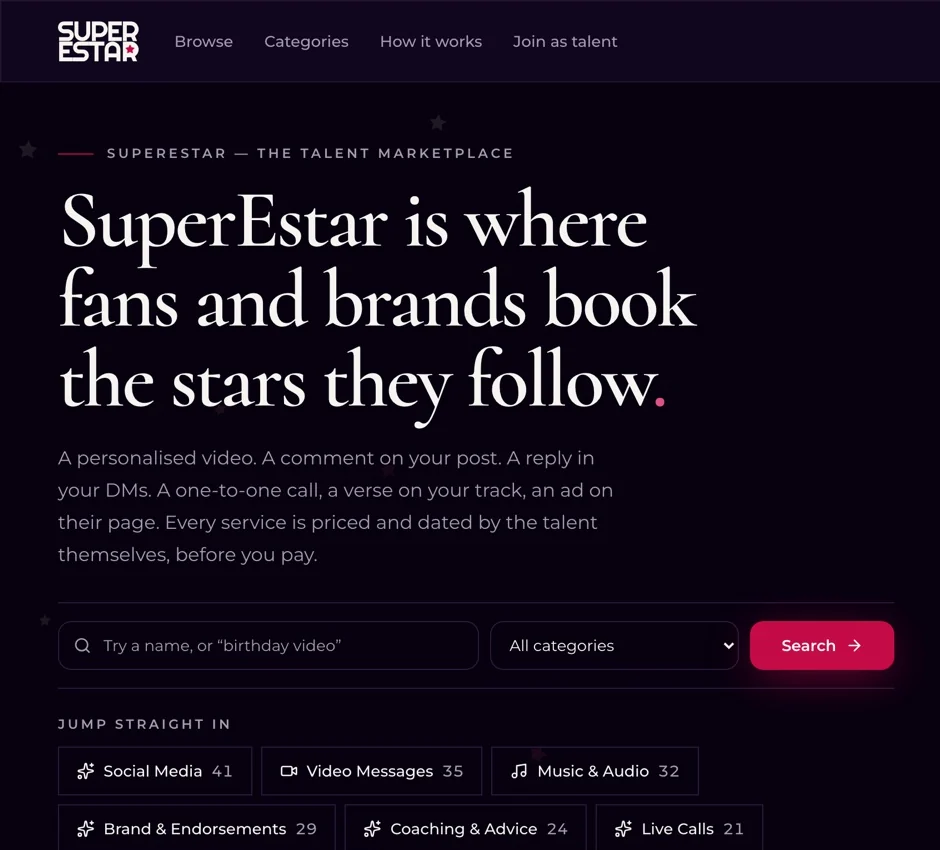
The new landing page beat the old one with every judge. I had 3 complete designs built (Editorial, Live Marketplace and Cinematic Stage), then scored each one against three briefs: conversion, visual craft, and mobile and accessibility. Editorial won on all three (94, 90 and 115, against 35, 40 and 59 for the old page), because its headline was the only one that named the product, both audiences and the action: "SuperEstar is where fans and brands book the stars they follow." It lets type carry the page, with maroon as the only accent and no gradients, where the old page leaned on a gradient hero and a particle star field. Then the winner took the losers' best bits, like the search box and live category counts.
How I built it
I turned my research and designs into a live marketplace. I hired a developer to build the first version, it launched in March 2023, and the build ran 12 months in all.
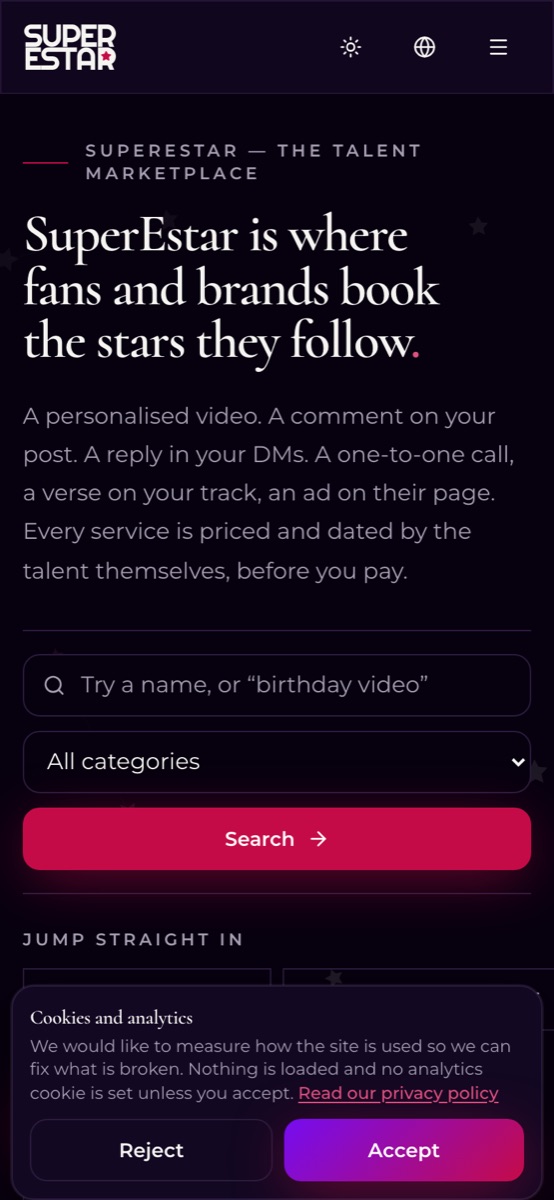
By 2026 it had 568 features, about 200 of them half-built. English shoppers were seeing Persian service names, and the homepage headline, "Superestar Connect", never said what the site sold. A visitor who can't tell what you sell doesn't book.
In 2026 I rebuilt it in 4 days. I set the rules up front. Build from scratch beside the live site, and keep every feature, half-built ones included. Use real accounting with mock payments, and make it work at every screen size. The first working build shipped overnight, between 1:06 and 5:27 a.m., and the new version came in at 60 routes and about 72,000 lines of code, guarded by 528 passing tests.
First, all 516 files of the first version were read and mapped. A first pass listed every feature, then a second pass tried to prove the list incomplete and found 60 more, which is how it reached 568, and that list became the build checklist. The money code was written test-first, and randomized fuzz tests on the ledger caught a real clawback bug on the first night.
QA walked the product on seeded test accounts at 375px and 1440px, and fixes were split by file ownership so no two changes collided. I had every "fixed" claim re-tested, and the log records the ones that weren't. The contrast check even found a bug in its own measuring tool, which moved the real baseline from 47 failures to 63.
What changed
The 2026 version of SuperEstar runs in English and Persian on a ledger that balances to the cent, and it took 4 days against the 12 months the first build took. A contract team would have needed 3,000+ hours and $200K+ to deliver it. The live site stayed up the whole time with zero restarts, and the new version runs on staging, hidden from search engines, until launch.
Every one of the 568 features got checked. 386 came out better and 64 the same. 64 were partial, 15 were missing, 38 were dropped on purpose and 1 is still unknown. The check also caught 2 features the rebuild had quietly lost, and both were rebuilt.
Some things work now that never did, like password-reset email and the contact form. Browse filter chips on a phone went from working 8 times in 20 to 20 in 20. Undersized touch targets dropped from 1,084 to zero, with full-size targets for real controls and the accessibility minimum for dense admin tables. Contrast failures fell from 63 to 15.
Once image optimization actually ran, one 56px avatar shrank from 93,388 bytes to 636 and the desktop homepage got 3x lighter. Most laptops had been getting the single-column phone layout, so the breakpoints moved and they now get the real desktop design.
The ledger balanced across all 1,001 seeded demo transactions with zero unbalanced, so the books add up before a single real dollar moves through them.
What's next
Next I'm moving the new version onto the main site and switching on real payments through the one-file swap the ledger was built for. Then I'll put the new landing page in front of real fans and talent, measure bookings against the old one, and build the referral rewards 35% of fans asked for. And I'll ship the Persian catalogue, with new database columns and a named owner for the text, so every category, service and bio reads natively for 110M+ Persian speakers.